Principal UX Designer
Crisp
Re-aligning a Growth-Stage B2B Website During Rapid M&A
Redesigned GoCrisp.com established a scalable, solution-driven website that realigned the experience with Crisp’s expanded product portfolio and diverse audiences. The initial set of priority pages immediately delivered a 2–3× increase in engagement time, reduced bounce rate by 75%, nearly doubled the proportion of engaged users, and increased interaction depth by 60%, demonstrating the direct impact of UX strategy on business performance.
Problem
After closing a $72M Series B, Crisp completed four acquisitions within nine months, bringing Shelf Engine, Atheon Analytics, ClearBox Analytics, and Cantactix, and their products into the platform. As new products were introduced and others sunset, the website no longer reflected the company’s strategy, product mix, or target audiences. Over time, the site had been simplified almost entirely to “Book a Demo,” stripping away clarity around what Crisp actually does and how its offerings map to customer needs. This misalignment created friction between marketing, sales, and prospective customers, and limited the site’s ability to educate, engage, or convert.
Solution
Established the end-to-end blueprint for Crisp’s redesigned website, delivering a scalable information architecture, solution-driven content model, and page-level wireframes to support a rapidly expanding product portfolio. The work aligned executive vision with user needs and produced a prioritized roadmap that now serves as the foundation for site redesign, content creation, and ongoing build efforts.

My Role
Lead UX Strategist and Designer responsible for discovery, synthesis, site architecture, and wireframe design across the full engagement.
Key Responsibilities
Planned and conducted stakeholder outreach and interviews, including scheduling, moderation, and synthesis
Authored moderator guides and interview scripts; captured notes and produced consolidated insights with recordings
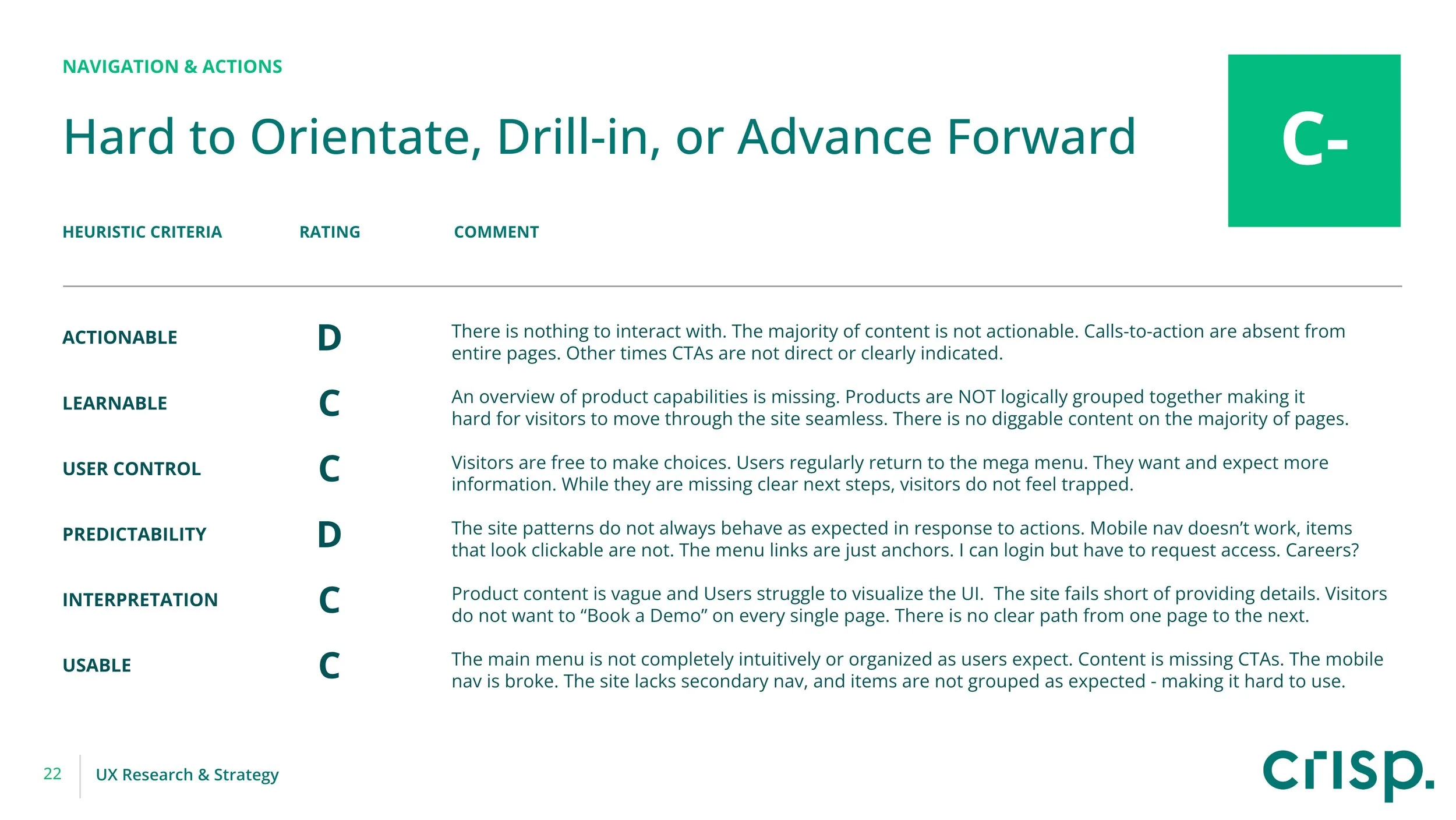
Audited website content and sales decks to identify product positioning gaps and inconsistencies
Partnered directly with the CEO and CMO to align on strategy, vision, and success criteria
Led competitive analysis of product and solution pages to inform structure and messaging
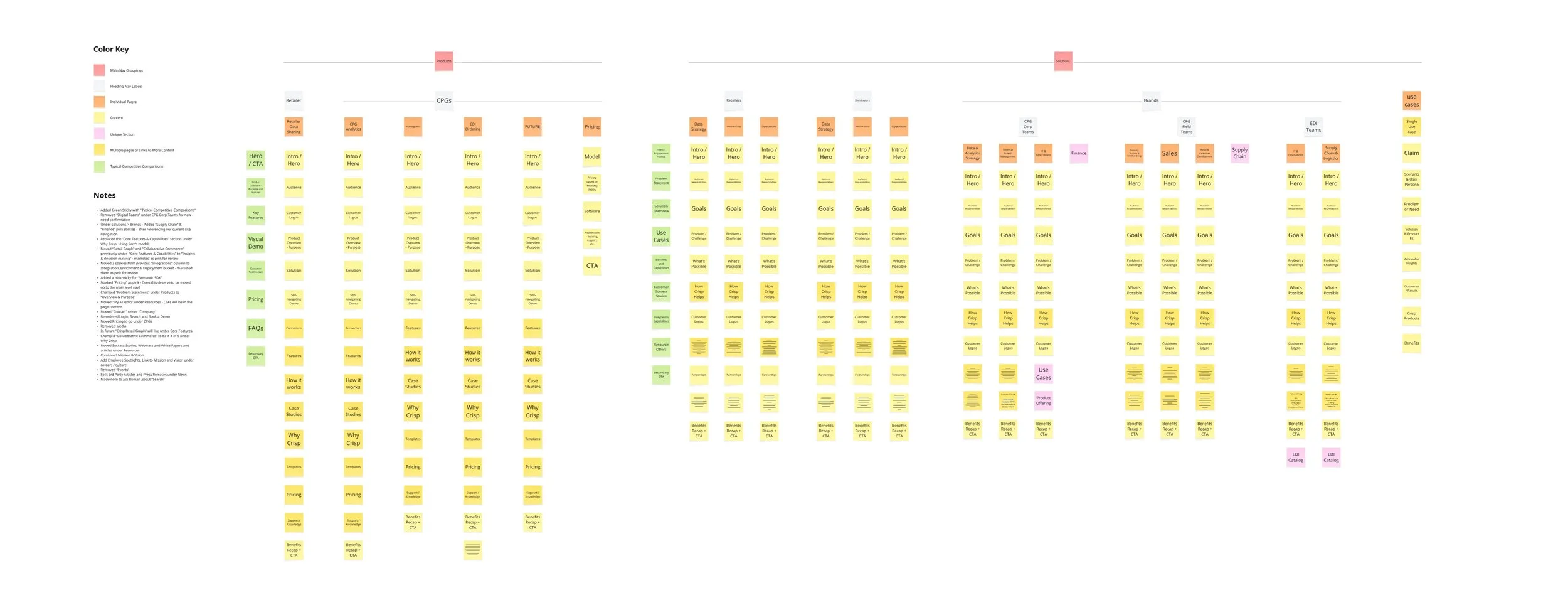
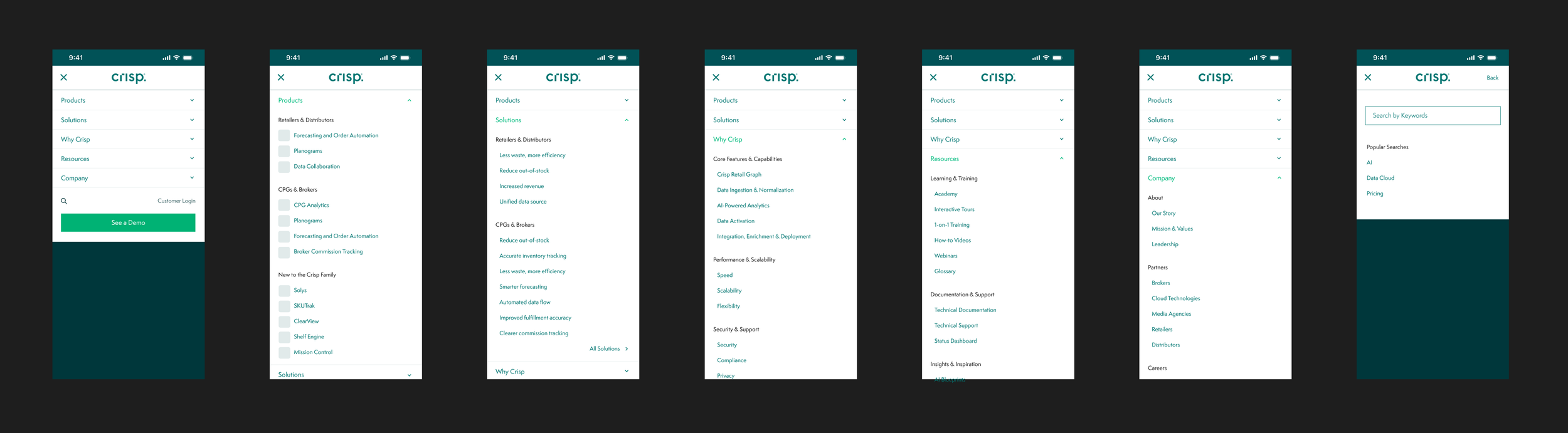
Defined a new site architecture and content framework
Curated and created modular content components to support scalable page design
Outlined page-level content and wireframed all future pages
Wrote detailed requirements for complex, feature-rich areas such as Search
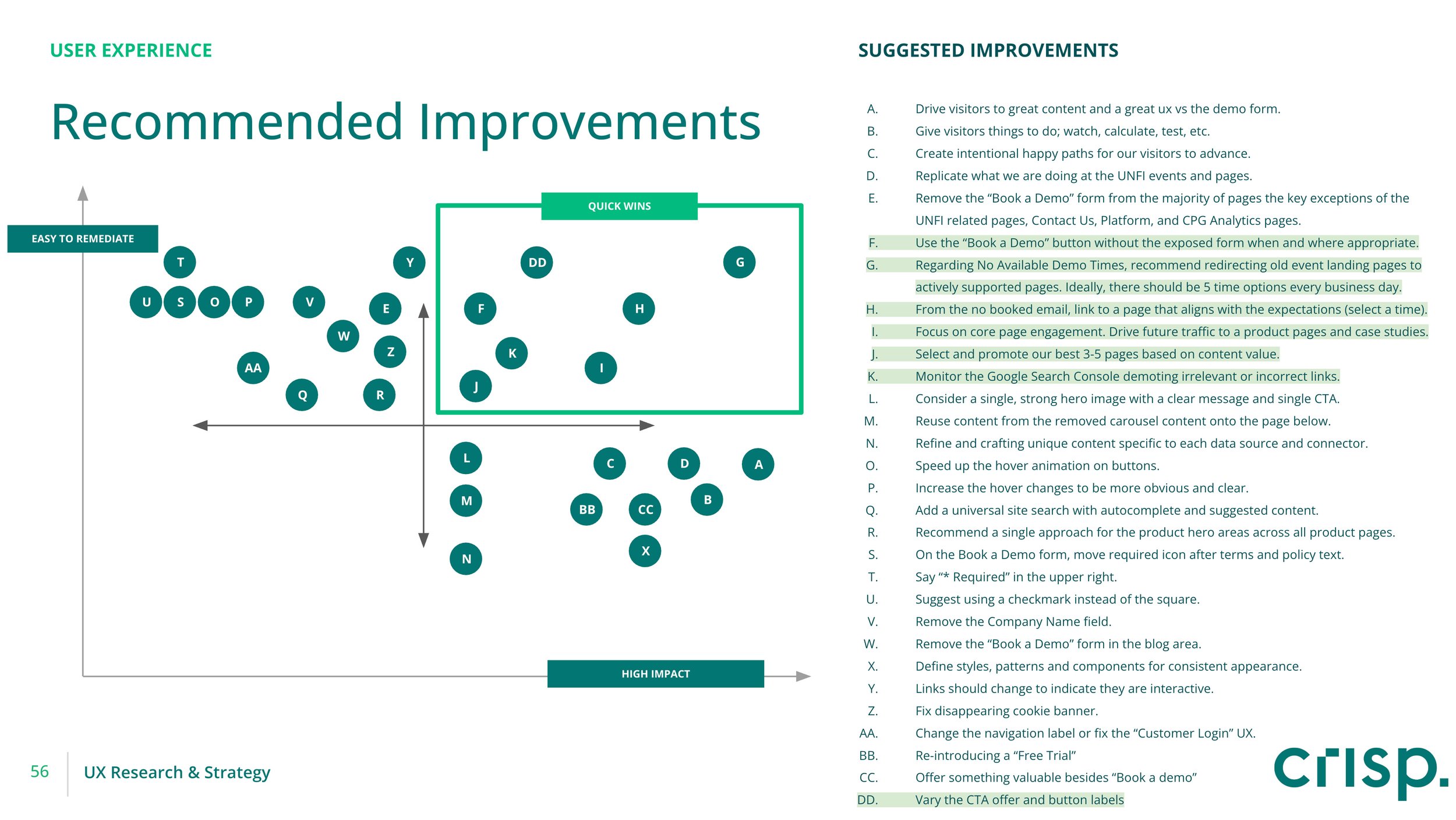
Delivered an executive-ready audit deck with prioritized recommendations
Supported Marketing, UI Design, and Engineering teams during handoff and early execution

CHALLENGE #1
Evolving Product Landscape and Site Complexity
As Crisp expanded its product suite, the site’s information architecture became bloated and inconsistent. Users struggled to understand the value proposition or find relevant content. The solution focused on restructuring the IA around scalable, modular solution narratives rather than fragmented product listings, enabling clarity and future growth.
CHALLENGE #2
Diverse Audience Needs Following Acquisitions
Multiple acquisitions introduced new personas and markets. The existing site focused on a smaller audience, treated all users the same, resulting in generic messaging and weak relevance. I introduced audience- and outcome-based solution pathways that better reflected how retailers, Distributors, Brokers, and CPGs evaluate value.
CHALLENGE #3
Siloed Content and Missed Engagement Opportunities
Product pages were disconnected from case studies, educational content, and supporting assets. The site lacked ways for visitors to engage. This limited exploration and trust-building. The redesigned solution pages intentionally cross-linked high-value content to support learning, validation, and deeper engagement.
Overall Performance Lift (Old → New)
Post-launch solution page(s) performance data showed a dramatic improvement across key engagement metrics:
1. BOUNCE RATE
Old solution pages (average):
Function-based pages ranged roughly 38%–65%
Practical average ≈ 52–55% bounce rate
New solution pages (average):
Most pages fall between 5%–16%
Practical average ≈ 10–12% bounce rate
Average improvement:
~40–45 percentage point reduction
This is a ~75–80% relative improvement in bounce rate
Moves pages from “needs investigation” to “well beyond excellent”
2. ENGAGEMENT TIME
Old solution pages:
Typical engagement time ≈ 19–25 seconds
New solution pages:
Retailer/Distributor pages ≈ 31 seconds
CPG pages ≈ 72 seconds (1:12)
Average improvement:
Conservative blended average ≈ +20–30 seconds
That’s roughly a 2×–3× increase in time spent engaging with content
3. PERCENT ENGAGED
Old solution pages:
Typically 43%–55% engaged
New solution pages:
Retailer/Distributor ≈ 82%
CPG ≈ 84%
Average improvement:
+30–40 percentage points
Nearly double the proportion of engaged users
4. EVENTS PER USER
Old solution pages:
Generally 2.3–2.9 events per user
Average ≈ 2.6
New solution pages:
Retailer/Distributor ≈ 3.1–3.8
CPG ≈ 3.8–6.0
Blended average ≈ 4.2–4.5
Average improvement:
+1.6–1.9 events per user
~60–70% increase in interaction depth
These results validated both the structural changes and the underlying content strategy, while also revealing opportunities to further optimize CTAs and surface higher-value assets earlier in the page hierarchy.:
Final Reflection
This project reinforced the importance of aligning UX strategy with business reality, especially during periods of rapid growth and acquisition. The strongest gains did not come from visual redesign alone, but from clarifying positioning, reducing cognitive load, and meeting users where they are in their decision-making journey. The work established a scalable foundation that Crisp can continue to evolve as its product portfolio and customer base grow, while proving, through data, that thoughtful UX strategy directly drives engagement and business outcomes.