Senior UX/UI Designer
PeaceHealth
Unlocking Care Discovery and Patient Access
As a team, we modernized care discovery, addressing fragmented journeys, high cognitive load, and inconsistent experiences across care units, providers, hospitals, and search.
Problem
PeaceHealth’s website supports millions of patient journeys each year, yet prior updates focused primarily on visual refreshes in 2022 and brand alignment in 2023, leaving core UX challenges unresolved. Critical experiences, including care units, provider profiles, hospitals, and search, remained fragmented, difficult to navigate, and inconsistent across entry points. As patient expectations evolved, the site no longer provided the clarity, guidance, or accessibility needed to confidently find and access care.
With over 9 million annual views across Oregon, Washington, and Alaska, even small UX inefficiencies compounded into meaningful friction at scale. The organization needed to shift from incremental fixes to a cohesive, data-driven UX strategy that supported continuous improvement.
Solution
In 2025, I partnered with PeaceHealth’s digital team to evaluate and redesign the core care discovery experiences across PeaceHealth.org. The engagement established a multi-phased UX strategy focused on simplifying care access, reducing cognitive load, and consolidating templates and components to lower long-term UX and technical debt.
The work delivered a unified experience across Care Units, Providers, Hospitals, and location-based pathways, balancing simplicity with enough context to support confident patient decision-making, while evolving the visual system without starting from scratch.
My Role
Lead UX/UI Strategist and Designer responsible for discovery, strategy, UX and UI design, and development support.
Key Responsibilities
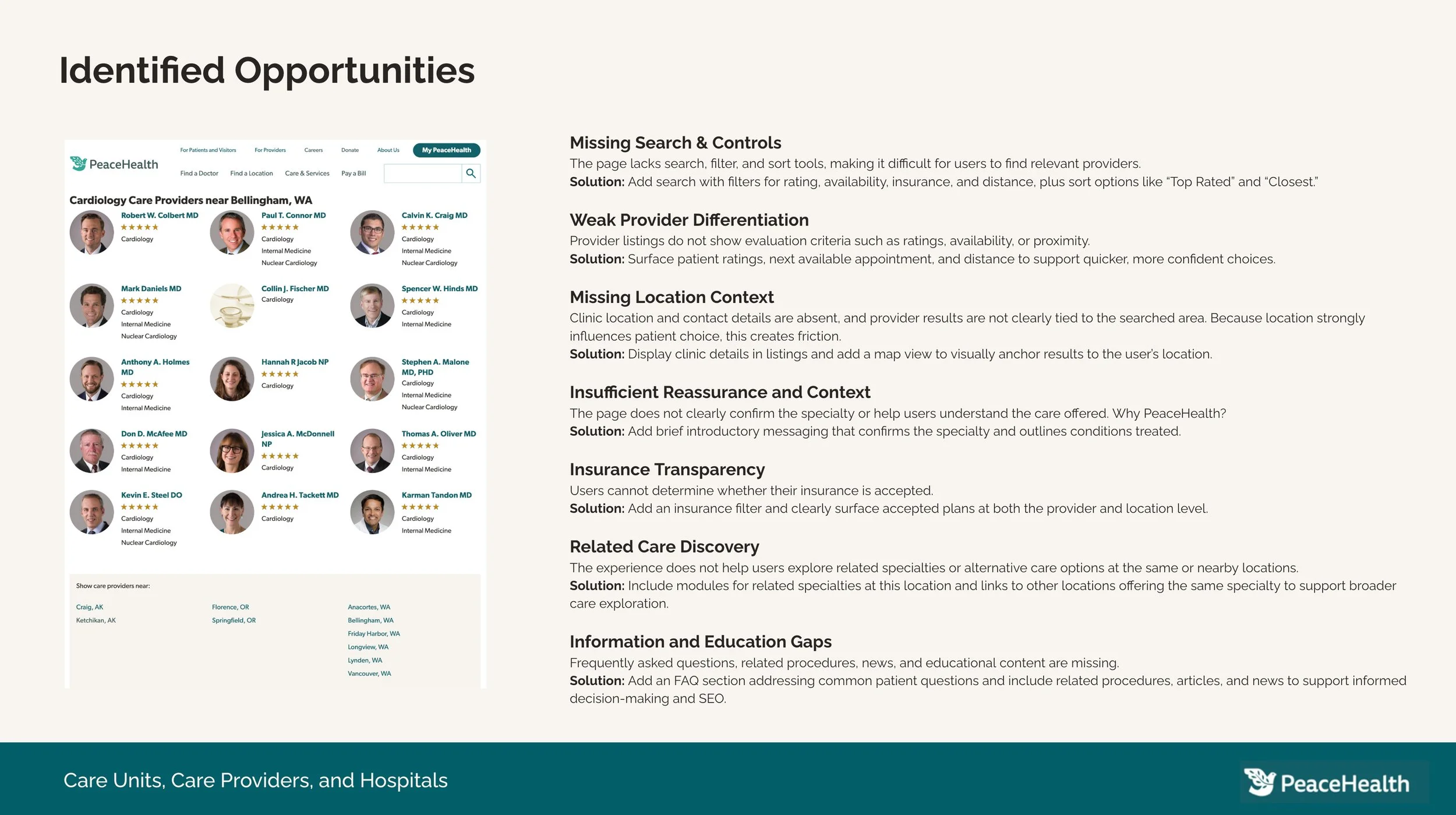
Surfaced known needs and collaborated with other researchers to identify digital gaps through interviews
Led heuristic evaluation and competitive UX and UI analysis of priority site sections
Supported the prioritization of high-impact UX initiatives
Designed and iterated wireframes, page flows, and responsive UI pattern
Consolidated templates and components into a scalable system
Established a foundational digital design system
Wrote UX recommendations, requirements, and implementation guidance
Provided UX review, QA, and support during development
CHALLENGE #1
Fragmented Entry Paths and Inconsistent Journeys
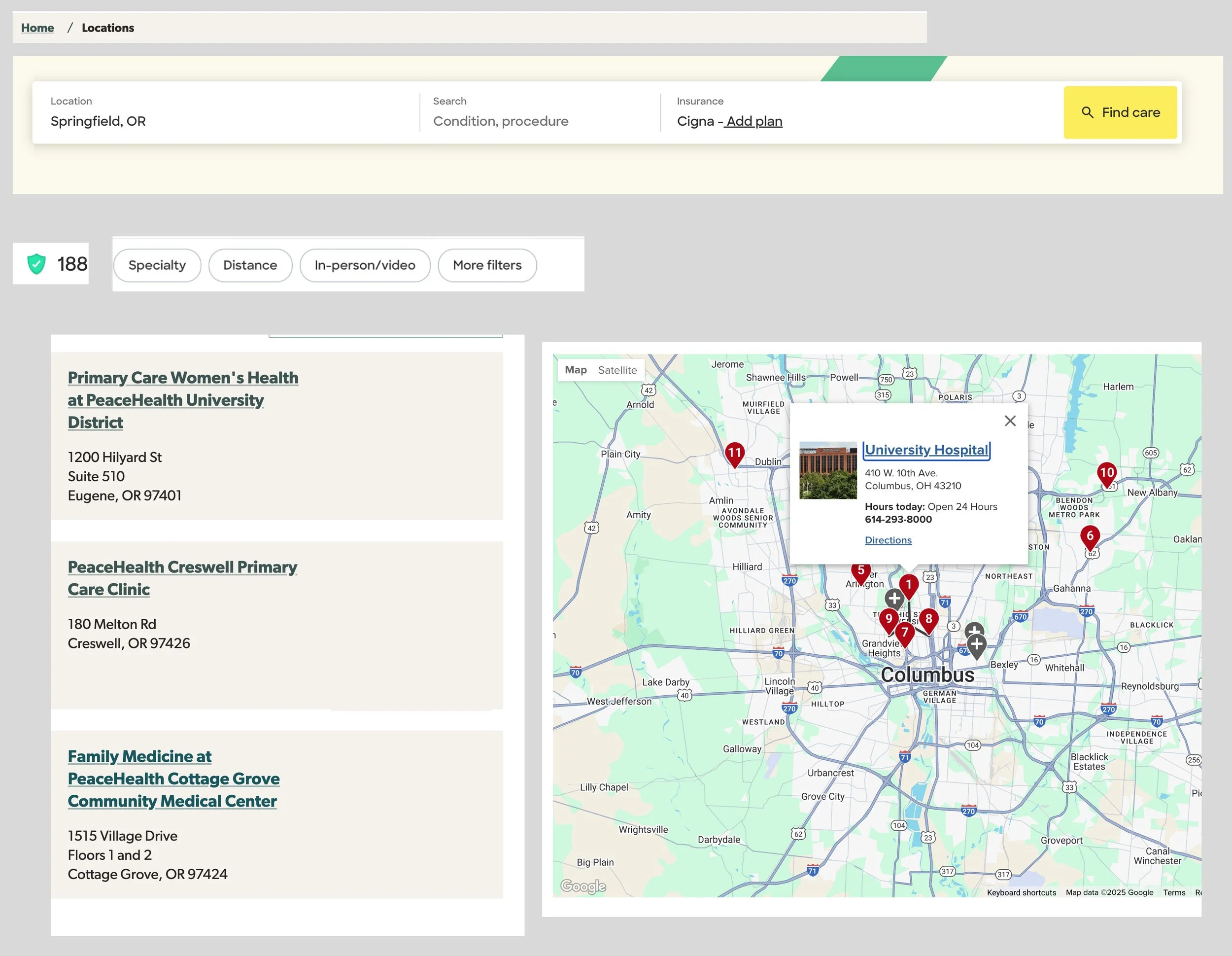
Patients arrived through multiple entry points, including Google search, directories, care services, or location pages, each with a different UX and none fully optimized. This fragmentation increased cognitive load and made it harder for users to progress toward care.
Approach:
Taking from best-in-class examples, I defined a unified, context-aware UX that adapts components and priorities based on entry path, creating a consistent and optimal experience regardless of how users arrive.
CHALLENGE #2
Complex Content Types with High Cognitive Load
Care Units, Provider Profiles, and Hospital pages each serve different user intents, yet shared inconsistent layouts, redundant elements, and unclear hierarchies. This made it harder for patients to evaluate credibility, availability, and next steps.
Approach:
Redesigned core templates around clear intent signals and success metrics, improving scanability, reducing click paths, and surfacing the most relevant actions at the right moment.

CHALLENGE #3
UX and Technical Debt from Template Proliferation
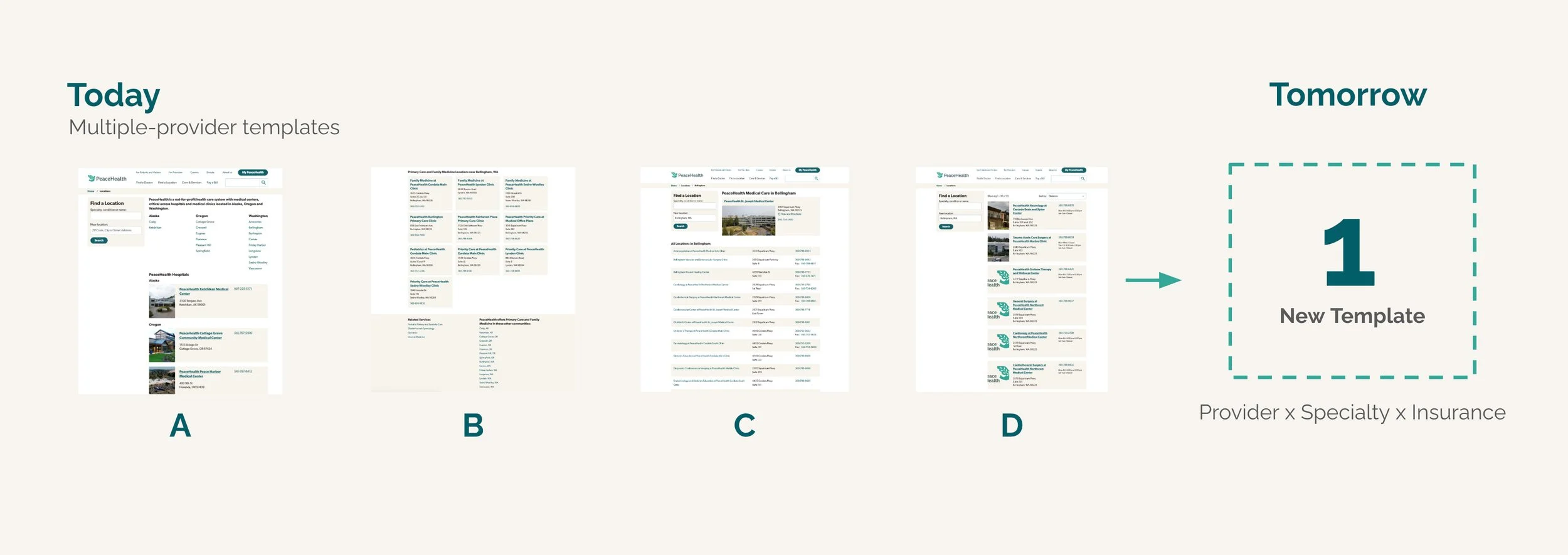
Over time, similar content had been implemented across 12 templates, increasing inconsistency and maintenance burden.
Approach:
Evaluated repeating components and consolidated pages into one new template. This reduced UX fragmentation while improving scalability.
Impact & Outcomes
Defined a patient-centered UX strategy aligned to PeaceHealth’s goal of becoming a digitally enabled first choice for care
Delivered evidence-based wireframes for Care Units, Providers, Hospitals, and routing experiences
Established a foundational digital design system to improve accessibility, consistency, and speed of iteration
Reduced UX and technical debt through template and component consolidation
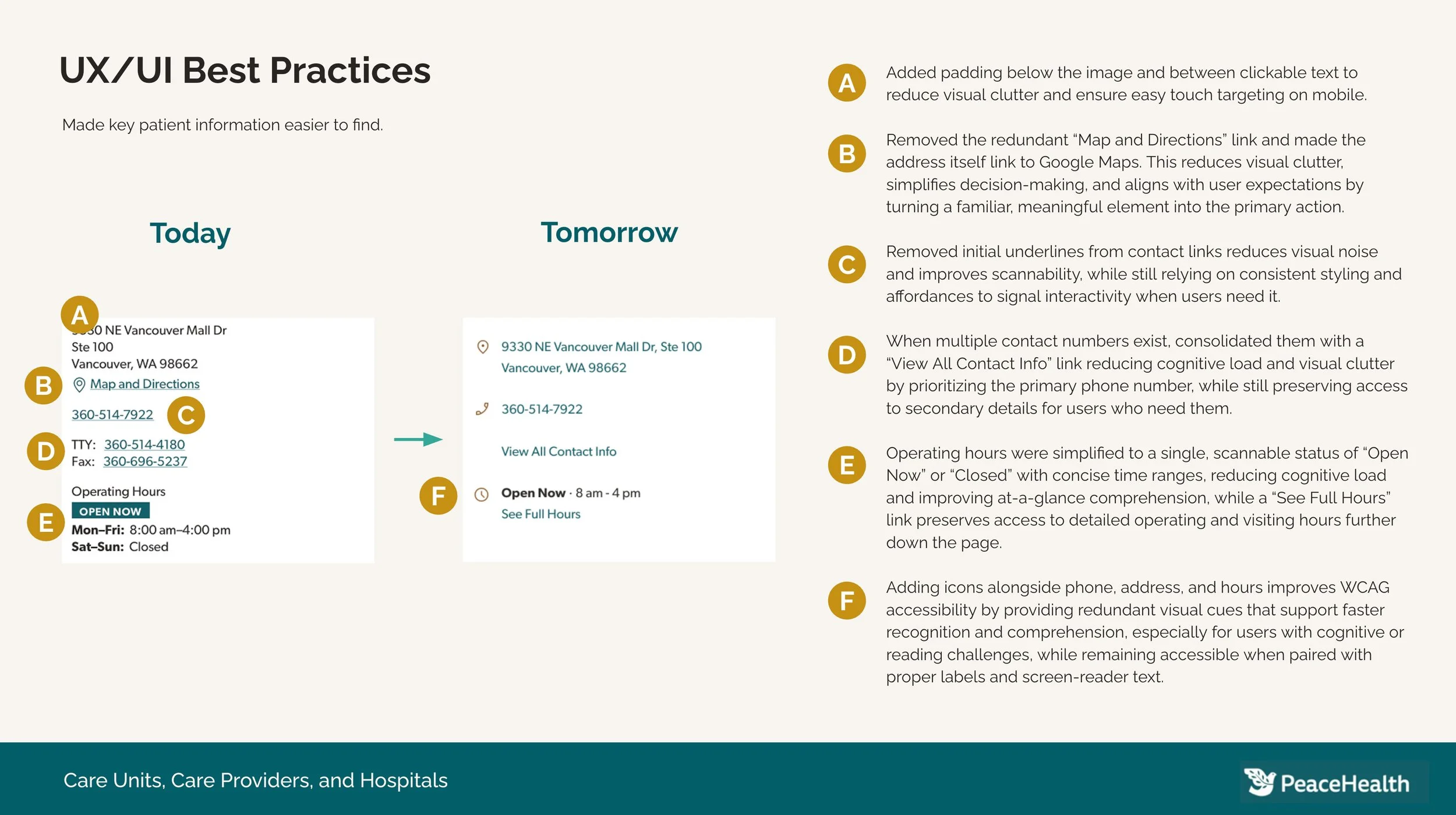
Improved clarity, scanability, and accessibility through refined interaction patterns for all related components and pages
Collaborated on the prioritized roadmap to guide phased implementation and continuous improvement
Final Reflection
This work represented a shift in mindset, from one-time redesigns to continuous, data-driven UX evolution. By grounding decisions in patient intent, behavioral signals, and best-practice patterns, the team created a scalable foundation that improves care discovery today while enabling PeaceHealth to adapt as patient needs, content, and digital capabilities evolve. Rather than redesigning pages in isolation, the engagement reframed PeaceHealth.org as a connected decision-support system for millions of patient journeys.